Build notes
How We Built Stashed Using AI (And Almost Lost Our Minds)
This is not a generic AI-business listicle. It is the actual messy story of how Stashed came together.
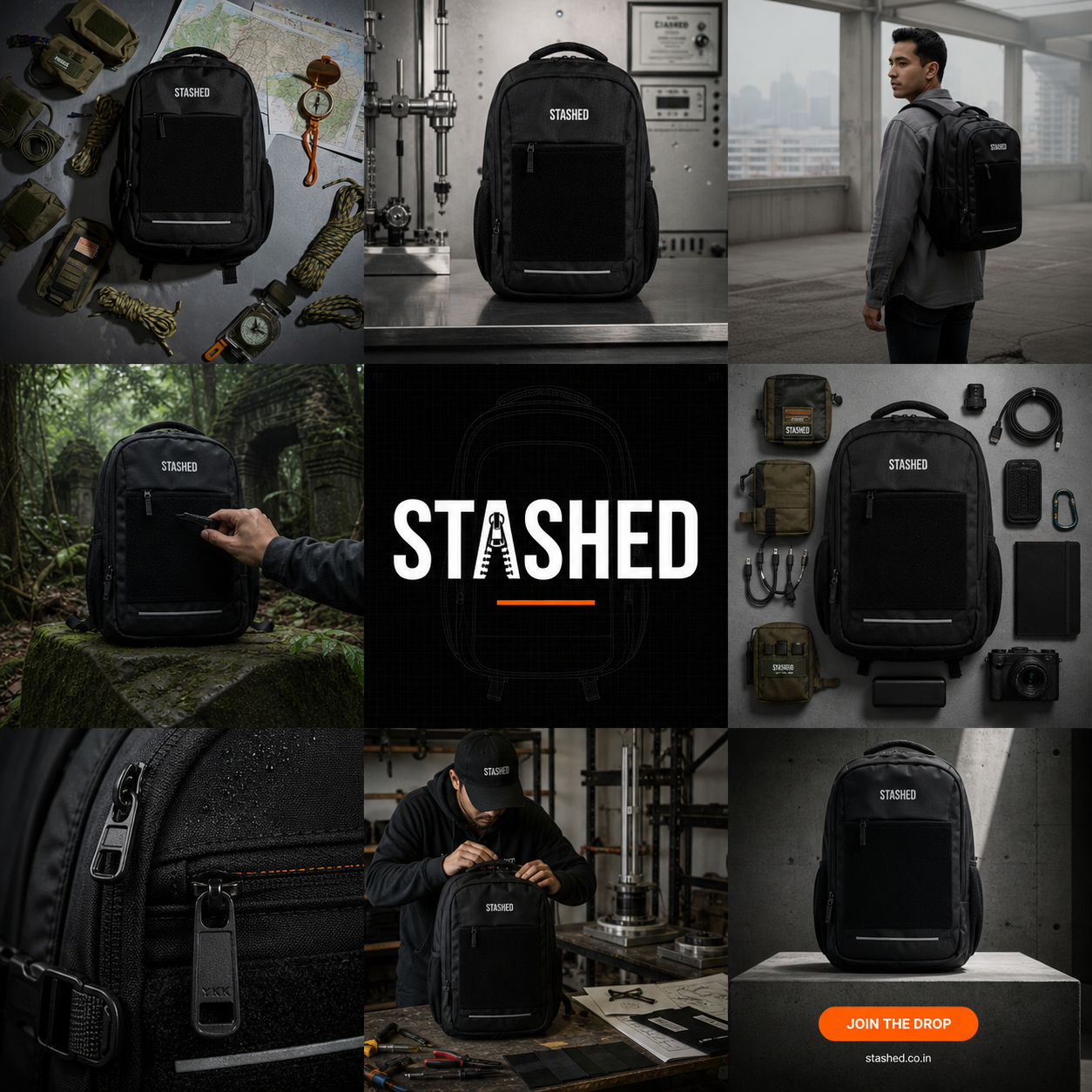
Let us get one thing out of the way: we did not have a startup budget. No VC money. No marketing team. No agency. We had a jewellery shop on the ground floor, a room on the first floor, two laptops, and an internet connection that dropped every time it rained.
And somehow, we built Stashed - a bag brand - using AI.
This is not a “10 ways AI can help your business” post. This is the messy story of how two boys from Vaniyambadi used AI to do work that would normally need a much bigger team.
The name came from Claude, sort of
We knew we wanted a bag brand. We knew it had to feel Indian without feeling costume-like. Modern without feeling fake.
We spent days trying to come up with names manually. Most of them were terrible.
Then we opened Claude and asked for brand-name directions around carrying, storing, motion, and youth culture. Most of those suggestions were still mid. But “Stashed” was in there.
The moment we read it, both of us felt it. That was the one.
Claude did not build the brand alone, but it helped us move through naming, positioning, taglines, and brand-language faster than we could on our own.
Visual identity without a design team
We needed product shots, social content, and a visual language. We could not afford a photographer or a design team for every iteration.
That is where Nano Banana entered the picture.
The early outputs were rough. Straps in weird places. Zippers that made no sense. Bag shapes designed by what felt like somebody who had only heard of bags second-hand.
But we learned quickly. Prompting got sharper. The more precisely we described material, color, hardware, and framing, the more usable the result became.
The images started doing something important: they made the product feel real before the first batch was fully ready.
The copy machine
Every product description, every Instagram caption, every email draft - Claude handled the first pass.
But the lesson was obvious very quickly: AI can draft, but humans still have to decide the vibe.
The best-performing copy was never the untouched AI version. It was the AI version after we cut the stiff parts, added our tone, and made sure it sounded like us.
The rule became simple: AI writes. Humans vibe-check.
Video changed the pace
Static posts were fine. Reels moved attention faster.
We started using Veo 3.1 for reveal videos, product motion, and more polished brand clips. For quicker social-first content, Higgsfield gave us faster output that felt native to the feed.
One small Velcro-panel swap clip outperformed almost everything we had posted before it.
Manufacturing is where AI hit the wall
Here is the honest part: AI is incredible on the digital side. But physical products still answer to reality.
AI cannot tell you how a zipper behaves after repeated use. It cannot feel the difference between one fabric and another. It cannot tell you whether the bag feels right on a crowded bus in Chennai.
That side belonged to manufacturing knowledge, local testing, materials, iterations, and the actual work around SN Bags.
AI helped us think better and move faster through:
- naming
- positioning
- visuals
- copy
- first-wave product storytelling
- research and documentation
But the bag still had to survive physical truth.
That is the whole point.
The chaos was real
We are not going to pretend this process was smooth.
There were nights where:
- Claude hallucinated material information and we had to double-check everything
- an AI-generated product shot created expectations the real product had to catch up to
- automation flows broke in annoying ways
- visuals looked too generic until we added more brand-specific detail
Every one of those mistakes taught us something. We documented them. The workflow got stronger.
What AI actually did for us
AI did not build Stashed by itself. What it did was compress time.
It helped us:
- move faster
- spend less
- expand into skills we did not formally have
- make the blurry parts visible sooner
That visibility matters. Better visibility leads to better decisions.
What AI did not do
It did not make the decisions for us.
It did not replace manufacturing knowledge.
It did not create trust with customers on its own.
It did not remove the anxiety that comes with trying to build something real.
What we would tell our past selves
- Start prompting badly. You only get good by doing the ugly first hundred reps.
- Do not hide the AI. People care whether the product is good.
- Build a system, not a trick.
- Keep the human in the loop.
- Document everything.
Stashed exists because AI helped us move like a bigger team. But it also exists because two people stayed in the room long enough to push past the glamorous part and deal with the actual product.
That combination is the real story.